

Find your size
Slide to your foot length. We'll do the rest.
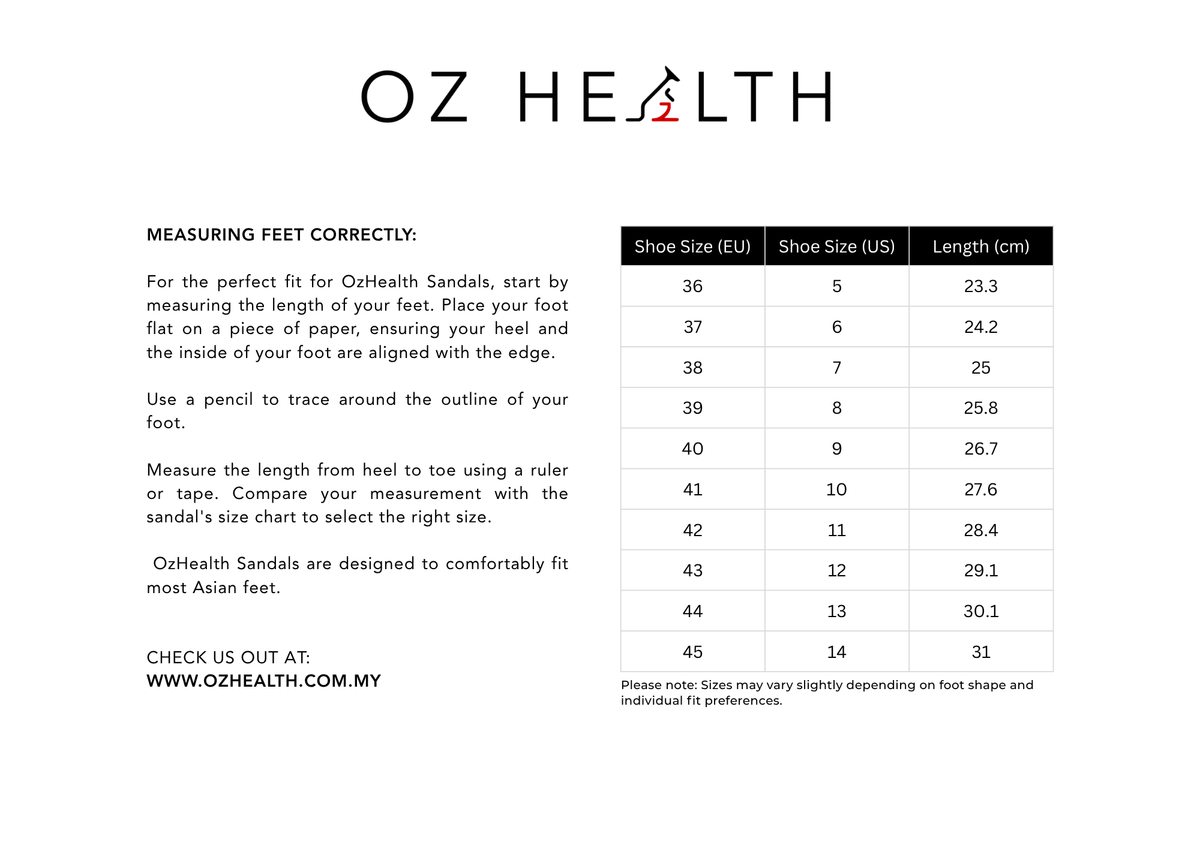
How to measure
- Stand on a sheet of paper with your heel against a wall.
- Trace around your foot and mark the tip of your longest toe.
- Measure heel to toe in cm. Measure both feet and use the longer one.
| EU | US | Foot length (cm) |
|---|---|---|
| 36 | 5 | 23.3 |
| 37 | 6 | 24.2 |
| 38 | 7 | 25 |
| 39 | 8 | 25.8 |
| 40 | 9 | 26.7 |
| 41 | 10 | 27.6 |
| 42 | 11 | 28.4 |
| 43 | 12 | 29.1 |
| 44 | 13 | 30.1 |
| 45 | 14 | 31 |
PosturArch Technology
Three-point support, built into every step.
Tap a point or a feature to fly the camera in. Move your mouse over the stage to tilt it.


-
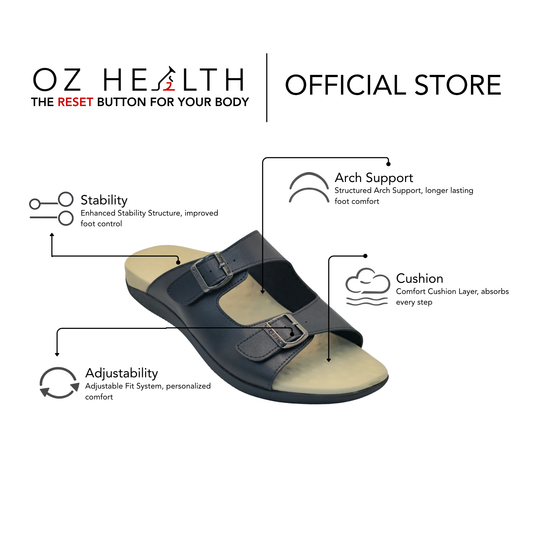
A precisely contoured rise supports the inner arch, redistributing weight evenly instead of concentrating it at the heel and ball of the foot.
Targets arch & heel pain -
Cradles the heel bone and keeps its natural fat pad in place, helping control overpronation (the foot rolling inward).
Controls overpronation -
A firm lower layer absorbs ground impact while a softer upper layer moulds to your foot, giving support you can wear all day.
All-day comfort -
A higher grade than standard PU or PVC, chosen to stay comfortable through Malaysian heat and humidity. Adjustable straps lock in your fit.
Made for the climate

 Barefoot
In Bendigo
Real photos: same person, same stance, barefoot and wearing Bendigo. Individual results vary.
Correct the base. Correct the chain.
Your feet set the posture for everything above them.
Switch between unsupported and PosturArch, then tap each joint to see what changes from the ground up.
Foot
Without arch support, the arch flattens and pressure piles onto the heel and the ball of the foot, a common source of heel pain and daily fatigue.
The medial arch support and heel cup spread your weight across the whole foot, so no single spot takes the load.
Ankle
The foot rolls inward (overpronation), pulling the ankle off-centre with every step.
A deep heel cup steadies the heel, helping the ankle stay centred as you walk.
Knee
The lower leg rotates inward, and the knee absorbs the twist, step after step.
With the ankle steady, the knee can track straighter over the foot.
Hip
The pelvis tilts to compensate, loading one side of the hip more than the other.
A level base helps keep the pelvis balanced through your stride.
Lower back
The spine curves to keep you upright, a frequent contributor to everyday lower-back ache.
Alignment built from the ground up means less compensation all the way to your lower back.
You may also like
-
Bendigo Arch Support Sandals- Olive Green
Regular price RM179.99 MYRRegular priceRM199.99 MYRSale price RM179.99 MYRSale -
Bendigo Arch Support Sandals- Black
Regular price RM179.99 MYRRegular priceRM199.99 MYRSale price RM179.99 MYRSale -
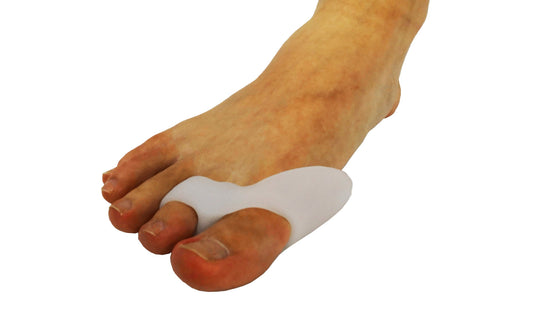
Oz Health Bunion Corrector
Regular price RM40.00 MYRRegular price -
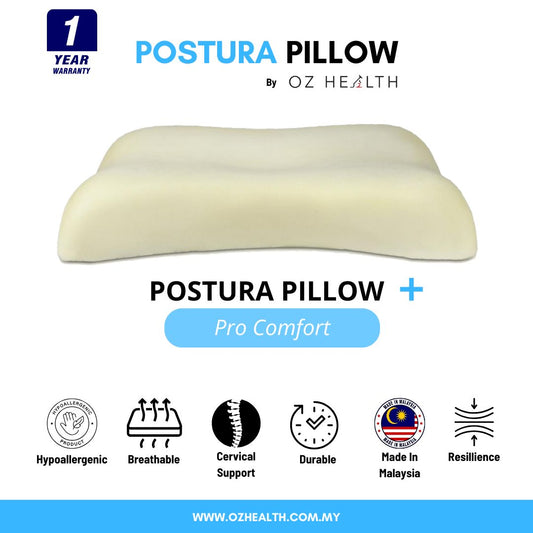
Postura Pillow by Oz Health - Pro Comfort
Regular price RM215.00 MYRRegular price