
What Is the Kinetic Chain and How Does It Affect Foot Health?
What Is the Kinetic Chain and How Does It Affect Foot Health?
Short answer: The kinetic chain is the concept that the body's joints, muscles, and connective tissues function as a linked system — where a problem at one point creates compensations throughout. The foot is at the base of this chain. Poor foot mechanics (flat feet, overpronation, improper footwear) create a cascade of compensatory dysfunctions affecting the ankle, knee, hip, and lumbar spine.
Closed Chain vs Open Chain
In biomechanics, a "closed kinetic chain" refers to movement where the distal end (feet) is fixed to the ground — such as walking, squatting, or standing. This is the most clinically relevant context: when standing and walking, forces generated at the foot travel upward through the entire system. Poor foot posture in closed chain movement has the greatest impact on the rest of the body.
In contrast, an "open kinetic chain" (feet free, as in leg raises) shows less transmission of foot dysfunction — which is why many rehabilitation exercises are initially performed in open chain positions before progressing to weight-bearing (closed chain) exercises.
The Foot's Role as Foundation
The foot performs three critical functions in the kinetic chain: shock absorption during heel strike, a rigid lever for propulsion during toe-off, and postural adaptation to uneven surfaces. All three require the arch to dynamically control pronation — allowing controlled collapse for shock absorption and then supinating for a rigid push-off.
When the arch cannot control this movement — due to flat feet, muscle weakness, or inappropriate footwear — the pronation is excessive and prolonged. The entire kinetic chain above is then subjected to rotational forces for which it was not designed.
Common Kinetic Chain Problems from Poor Foot Mechanics
Patellofemoral pain syndrome (runner's knee): Overpronation causes tibial internal rotation, which pulls the kneecap laterally, causing cartilage irritation. Arch support is a first-line treatment for runner's knee even in non-flat-footed patients.
IT band syndrome: Hip abductor weakness combined with foot overpronation is the most common cause. Correcting foot mechanics reduces IT band stress even without hip strengthening.
Gluteal and hip pain: Compensatory hip external rotation (used to counteract tibial internal rotation from flat feet) overloads the piriformis and external rotators, causing deep gluteal pain.
Lower back pain: As detailed in our article on footwear and back pain, pelvic tilt from foot overpronation directly increases lumbar load.
Rehabilitation: Starting from the Ground Up
In physiotherapy, we describe this as "proximal stability for distal mobility" — but the inverse also applies: "distal stability enables proximal function." Correcting foot mechanics with arch support often enables rehabilitation exercises to be more effective because the kinetic chain is operating from a stable foundation.
When treating a patient with knee pain, I always assess the foot. When treating a patient with hip pain, I assess the foot and knee. Starting rehabilitation without correcting the foundation is like renovating a house with a damaged foundation — the work is wasted if the base remains unstable.
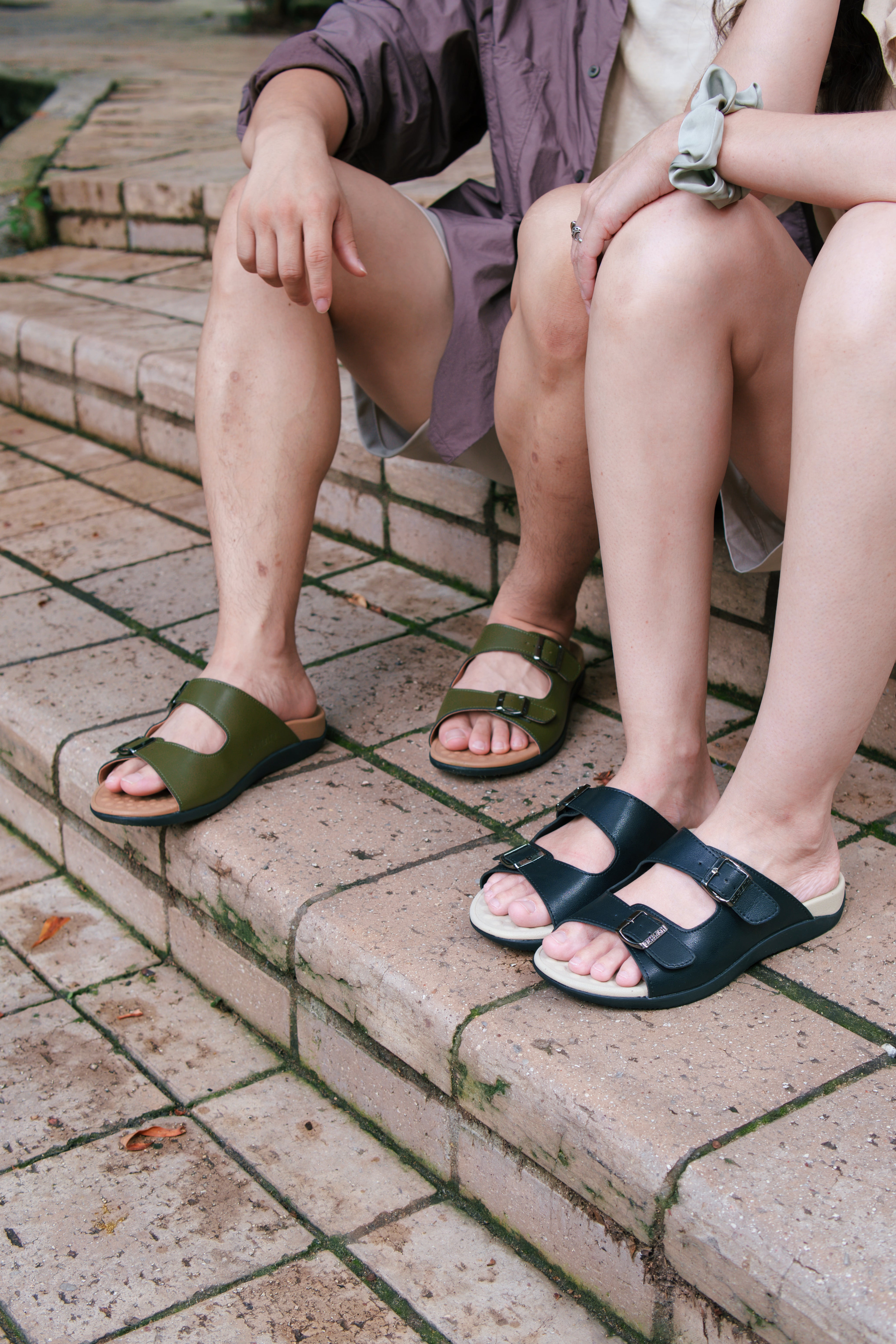
OZHealth PosturArch sandals are designed specifically for this biomechanical role: stable foundation support through medial arch contact, heel containment, and controlled pronation — the three features that establish a stable kinetic chain base.