
How to Choose the Right Arch Support for Your Foot Type
How to Choose the Right Arch Support for Your Foot Type
Short answer: Choosing arch support depends on your foot type (flat, neutral, or high arch), your activity level, and your footwear environment. A self-assessment takes 2 minutes: wet your foot, step on paper, and check the contact pattern. Flat feet need medial arch support with firm structure; high arches need cushioning and flexibility; neutral feet benefit from moderate support and shock absorption.
Step 1: Assess Your Foot Type
The wet foot test (footprint test) is the simplest self-assessment:
Flat feet (pronated): The footprint shows almost the entire sole — little or no curve on the inner edge. You need medial arch support that contacts the navicular bone when standing, a deep heel cup, and semi-rigid structure that controls (not blocks) pronation.
Neutral arch: The footprint shows approximately half the arch — a moderate curve on the inner edge. You need moderate arch support and cushioning. Standard orthotic insoles and quality orthotic sandals are appropriate.
High arch (supinated/cavus): The footprint shows a very narrow bridge between heel and forefoot — only the outer edge and ball are visible. High arches are rigid and poor at shock absorption. You need cushioning and flexibility, not firm arch support that further increases supination. Look for a cushioned insole with a contoured (but not elevated) arch.
Step 2: Assess Your Activity and Environment
Home (tiles/hard floors): Orthotic sandals are ideal — they provide support during the significant home barefoot time without requiring closed shoes. Priority: arch support height, heel cup depth, and cushioning for prolonged home standing.
Work (standing 6+ hours): Semi-rigid insoles in supportive closed footwear, or orthotic sandals if the work environment permits. Priority: arch support plus forefoot cushioning (metatarsal padding) for prolonged standing.
Running/sport: Sport-specific orthotics or stability running shoes. Running subjects the foot to 2.5–3x body weight — support requirements are significantly higher than walking.
Formal/office: Low-profile orthotic insoles in dress shoes. Moulded insoles that fit existing footwear are most practical for formal environments.
Step 3: Key Features to Look For
For arch support to be effective, it must:
- Contact the arch when standing: If you can slide a finger under the arch contour when wearing it, it is not providing support.
- Have a heel cup of adequate depth: Minimum 15–18mm for flat feet. Shallower cups do not contain the heel fat pad and reduce shock absorption effectiveness.
- Be semi-rigid, not fully soft: Soft foam insoles provide cushioning but not arch support. The arch needs a firm structure that resists collapse under body weight.
- Fit your shoe correctly: Insoles that are too large buckle or compress, losing their shape and support. Orthotic sandals must fit snugly — too large loses arch contact.
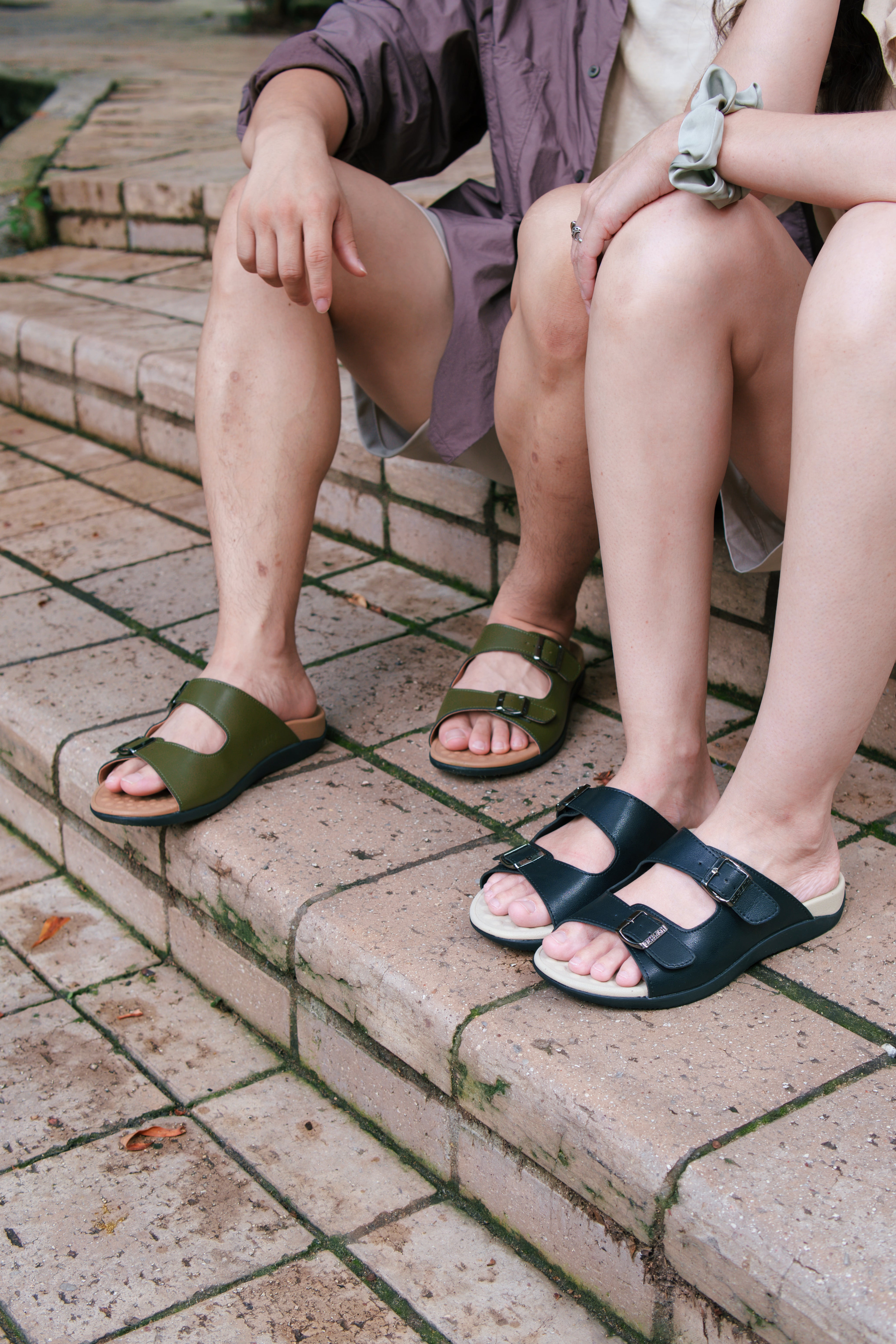
OZHealth PosturArch for Malaysian Foot Types
The OZHealth PosturArch is designed for the Malaysian foot profile — which on average has a lower arch index than Western populations. The medial arch contour, 22mm heel cup, and dual-density EVA address the three most common Malaysian foot health needs: arch support for high flat foot prevalence, heel containment for the hard tile home environment, and cushioning for prolonged standing in retail/healthcare/F&B.