
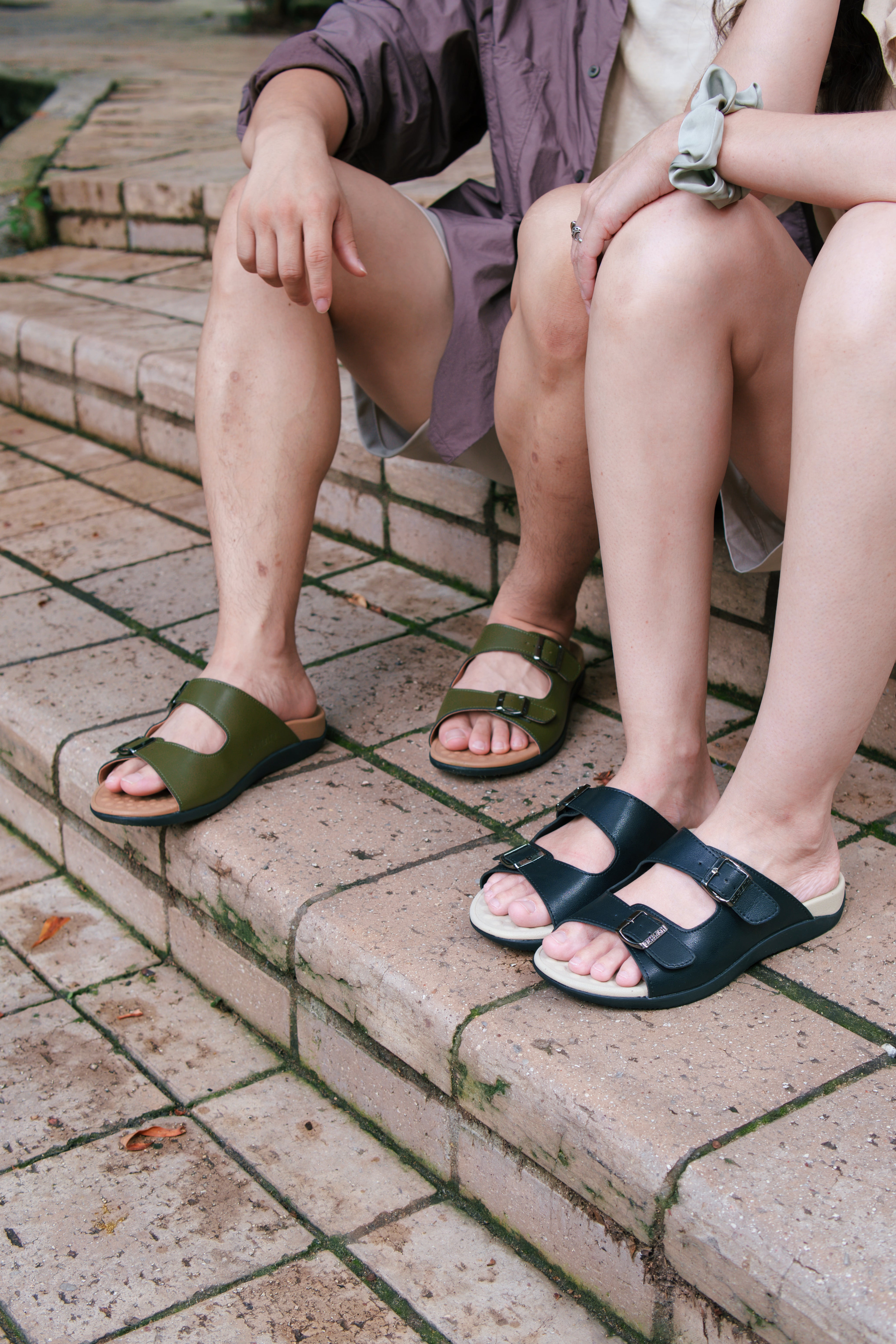
Arch Support Sandals vs Regular Sandals — What's Actually Different?
Arch Support Sandals vs Regular Sandals — What's Actually Different?
Short answer: Arch support sandals and regular flat sandals are fundamentally different structures despite looking superficially similar. The key differences: arch support sandals have a raised medial contour that contacts the arch (not just a raised shape), a deep heel cup (minimum 18mm walls), and a semi-rigid footbed that maintains its shape under body weight. Regular sandals have a flat or minimally raised footbed that provides no structural support. The differences are clinically meaningful — flat sandals are a leading cause of plantar fasciitis in populations that wear them regularly.
The 5 Structural Differences That Matter
1. Arch contour height and contact: A quality arch support sandal has a raised medial contour sized and positioned to contact the navicular bone when standing. You should feel the arch of the sandal pressing lightly against your inner midfoot when you stand on it. A regular sandal has a flat or nominally raised profile that does not contact the arch under weight — providing no functional support.
2. Heel cup depth: Arch support sandals have walls of 18–25mm around the heel — deep enough to contain the heel fat pad and prevent lateral heel splay. Regular sandals have 0–8mm of heel containment — the heel sits on a flat surface with no containment. The difference: after hours of standing, the heel fat pad in a regular sandal has expanded outward and lost its shock-absorbing capacity.
3. Footbed rigidity: Arch support sandals use semi-rigid EVA or polymer for the footbed structure — firm enough to resist collapsing under full body weight. Regular sandals use soft foam or rubber that compresses flat within hours of wearing, effectively eliminating any contour that was present when new.
4. Material durability: Quality arch support sandals maintain their structural geometry for 12–24 months of daily use. Regular flat sandals begin losing even their minimal cushioning within 3–6 months. The "worn in" feeling of a flat sandal usually means the foam is compressed and providing even less support than when new.
5. Midsole construction: Arch support sandals typically use dual or multi-density midsoles (firm structural layer + softer topcover). Regular sandals use single-density foam or rubber throughout — which cannot simultaneously provide support (needs firmness) and comfort (needs softness).
Why Flip-Flops and Budget Sandals Are Particularly Harmful
Flip-flops require the toes to grip the thong with every step — an unnatural movement that overloads the toe flexors and changes gait mechanics. The completely flat, flexible construction provides zero arch support, zero heel cup, and zero pronation control. In populations that wear flip-flops regularly (including most of Malaysia), flip-flop use is directly associated with increased plantar fasciitis, Achilles tendonitis, and metatarsalgia.
Budget flat sandals without toe thong are slightly better — no toe gripping — but still provide no structural support. At RM20–40, the materials are insufficient to maintain any arch contour under body weight. These are acceptable for brief casual use (beach, shower) but not as daily footwear for anyone who stands more than 30 minutes.
How to Test a Sandal Before Buying
Before purchasing, perform these 30-second tests: (1) Press your thumb firmly on the arch area — a quality arch support sandal resists compression; a regular sandal compresses flat. (2) Place the sandal on the floor and press down on the arch with your hand — it should not collapse. (3) Check the heel cup wall height with your finger — aim for at least 18mm. (4) Bend the sandal — arch support sandals should flex at the forefoot but resist twisting in the midfoot; regular flat sandals fold completely.
OZHealth PosturArch sandals pass all these tests: firm medial arch that resists thumb compression, deep 22mm heel cup, dual-density semi-rigid EVA midsole, and forefoot flexibility with midfoot stability.